

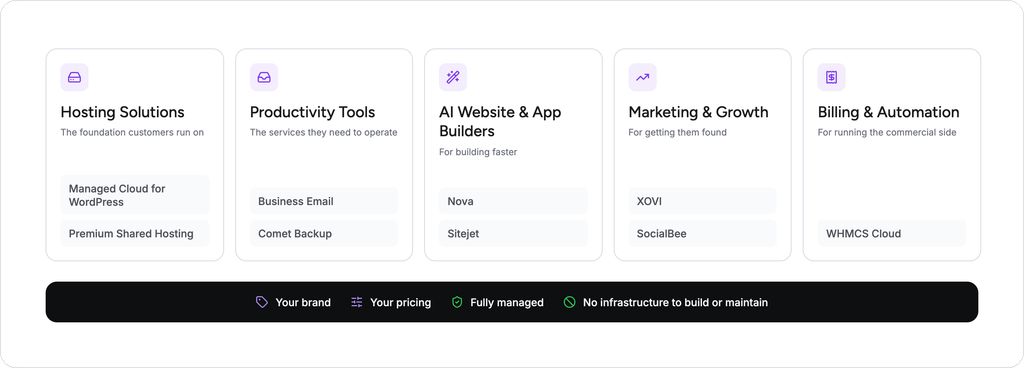
Customers do not stop buying once their website is live. They keep buying email, marketing tools, AI builders, and billing software, usually from four different vendors. For registrars, hosts and agencies, that spend is the clearest growth opportunity available, and most of it is currently walking out the door. The blocker is not demand. It is operational load. Every product you add brings vendors, infrastructure, integrations, support and billing complexity behind it, and those costs compound faster than the revenue does. WebPros Cloud closes that gap with five categories of fully managed, ready-to-sell solutions:
- Hosting Solutions for the foundation customers run on
- Productivity Tools for the services they need to operate
- Marketing & Growth for getting them found
- AI Website & App Builders for building faster
- Billing & Automation for running the commercial side
All resold under your brand, with your pricing, and no infrastructure for you to build or maintain. The result – higher ARPU, more wallet share, better retention and a proposition that competes on breadth rather than price.
Introduction
For most registrars, hosts and agencies, the customer relationship starts with one thing. A domain. A hosting plan. A website build. That first sale is still the easiest one you will ever make. It is also where a lot of partners stop.
Your customer keeps buying. Email, SEO, social tools, billing software. Each is another part of the digital business you helped bring online. Very few of them come back to you. So, the real opportunity is not selling another hosting package at a slightly better margin; it’s becoming the provider your customer turns for everything that comes after the website goes live.
Hosting may be where the relationship starts. It does not have to define what that relationship is worth.
Customers Need a Digital Presence. Partners Can Own More of It.
A small business getting online today needs a longer list of things than it did five years ago:
- Infrastructure to run on
- A website that looks credible
- Business communication that does not use a free consumer email address
- AI tools to move faster with a small team
- Marketing to actually get found
- Automation to stop doing repetitive work manually
- A way to bill, collect and manage the commercial side
The customer does not think of these as seven separate categories. They think of it as one job: get my business running online and keep it running. The fragmentation is not something the customer asked for. It is a symptom of how the supply side is organized. That gap is the commercial opening. When a customer must assemble their own stack from seven vendors, nobody owns the relationship. Whoever consolidates even half of it becomes very hard to replace.
For partners, capturing more of that spend can increase ARPU, grow wallet share, and create more recurring revenue. It can also strengthen retention by making your services more valuable to the customer. And with a broader offering, you have more ways to compete beyond price.
Expanding Your Portfolio Shouldn’t Mean Increasing Your Operational Burden
The obvious move is to add more products. That is also where most expansion plans quietly die. Every new product you take on brings a tail behind it:
- A new vendor relationship to manage
- Infrastructure to provision and maintain
- Integrations into your existing systems
- Support your team is not trained for
- Technical expertise you may need to hire
- Another billing line to reconcile
- Ongoing maintenance and updates
One product is manageable. Five products mean five sets of those tails, and those costs compound. Support tickets arrive in categories your team might not be equipped to resolve. Margin gets eaten by operational overhead nobody budgeted for. So, the question for a host, registrar, or agency is not whether to offer more. It’s how to expand the portfolio without having to build and manage more.
Hosting Solutions: Build the Foundation of Your Customers’ Digital Presence
Hosting remains the foundation. What has changed is that basic infrastructure is no longer where the majority of the value sits.
Managed Cloud for WordPress is a CloudLinux-backed WordPress environment designed for performance, security and simplified operations. Automated updates, security tooling, and flexible resource tiers are included as standard. This matters commercially because WordPress customers tend to generate support activity out of proportion to what they pay. Managed infrastructure resolves much of it before it reaches your team.
Many customer websites continue to run older PHP versions, and requiring an upgrade can disrupt a working site and create an issue that reflects directly on the provider. HardenedPHP keeps those sites secure without a risky migration, so customers can continue building and maintaining their websites safely while partners avoid difficult conversation.
Premium Shared Hosting is more than an entry-level tier. It is a cPanel-powered environment with site-level resource isolation, reseller-ready and white-labeled, scaling from single-site plans through to high-volume multi-site environments. Partners deliver a dependable hosting experience without owning the infrastructure that supports it.
How this translates by partner type:
- Registrars can convert domain customers into hosting customers and extend beyond the initial transaction
- Hosts can move existing customers into premium and managed tiers, increasing value per account
- Agencies can include hosting within project work, turning one-time builds into recurring revenue
Productivity Tools: Help Customers Run Their Digital Business
Once customers are online, they need to operate. That represents a different set of needs and an additional revenue layer.
Business Email is among the most consistently underused revenue opportunities in the industry. Every domain registered belongs to a customer who needs email at that domain, and where partners do not offer it, another provider will. WebPros Cloud – Business email is a cloud-based solution that includes dedicated IP reputation management, advanced spam protection, a modern webmail interface, and AI capabilities[coming soon]. Partners are therefore not competing on price against a basic bundled mailbox but offering a better standard of service that renews month after month.
Comet Backup operates differently but attaches to accounts just as naturally. Automated backups, military-grade encryption, modern deduplication and reliable restoration mean that a problematic update or a failed migration becomes a recoverable event rather than a lost website. For customers, it provides reassurance. For partners, it reduces the most disruptive category of support incident and offers a straightforward add-on that customers rarely cancel once they have relied on it.
How this translates by partner type:
- Registrars hold the largest natural opportunity here, as every domain sale and renewal is a moment where email can be attached, converting a single annual transaction into a monthly recurring relationship
- Hosts can offer a premium email experience beyond bundled, self-hosted mail, and position backup as a paid tier rather than absorbing recovery work as an unbilled support cost
- Agencies can build both into a monthly care or maintenance plan, where backup gives a customer clear, demonstrable value
AI Website & App Builders: Make Digital Creation Faster and More Accessible
Expectations around build time have shifted significantly. Customers increasingly want to launch a website, test an idea, or create a simple application within days rather than months.
Nova is an agentic AI website and application builder. A customer describes what they need, and AI agents build it, supported by no-code editing, live previews, AI image and video generation, a built-in backend with database and authentication, voice input and multi-language support. Ideas become working sites and applications in minutes.
Sitejet serves customers who prefer a complete website platform to a prompt-based approach. It brings together creation, hosting, SSL, email and collaboration in one solution, with a drag and drop builder, more than 170 templates and full white labeling. It suits agencies managing websites on behalf of clients, as well as end customers who want to build without moving between multiple tools.
AI is best understood not as another product line, but as an accelerator across the wider portfolio, because it shortens the distance between a customer deciding to act and the result going live. That means faster onboarding, quicker project delivery, and a considerably lower barrier for customers who might otherwise never have started.
In a market where differentiation frequently returns to price, this is one of the more meaningful points of difference currently available.
How this translates by partner type:
- Registrars can convert domain-only customers into website owners at the point of purchase
- Hosts can reduce the onboarding gap for customers who have bought hosting but have no website ready, while offering AI site and app builders
- Agencies can compress build timelines significantly, making smaller projects commercially viable and allowing to go live faster.
Marketing & Growth: Move from Getting Customers Online to Helping Them Grow
A website on its own does not create a successful business. Customers still need traffic, visibility and engagement
XOVI addresses the search side of this, and it arrives at a useful moment. Search visibility once meant ranking within a results page. Increasingly, it also means appearing within AI-generated answers. XOVI supports both keyword and rank tracking, technical site audits, a text optimizer for content improvement, and white-labeled reporting. A regular branded visibility report is what transforms a one-time SEO setup into a retained service, while helping customers reduce their reliance on paid channels.
SocialBee covers the other half of being discovered. It is an AI-powered social media management platform offering content creation, scheduling across multiple platforms, detailed analytics, and collaboration tools within a single interface. Small businesses generally recognize the value of consistent social activity but sustaining it manually across several networks requires time that most teams do not have.
This is the category that changes how customers perceive their provider. It moves the conversation from “we host your website” to “we help your business grow online.”
How this translates by partner type:
- Registrars can sell visibility services without any infrastructure dependency, which makes this category accessible even to customers who host their websites elsewhere
- Hosts typically sit on a large base of websites, and visibility reporting makes that opportunity straightforward to identify and act on
- Agencies have the closest natural fit, as white-labeled reporting and multi-account scheduling allow a small team to service many clients under a single monthly retainer
Billing & Automation: Simplify the Business Behind the Digital Business
WHMCS Cloud supports the operational and commercial layer beneath everything else. Billing, automation, provisioning, subscriptions and client management are delivered as a fully managed service, removing infrastructure responsibility from the partner. This category is best understood in two ways.
It is a product partners can sell. Any host or reseller operating a service business needs billing and automation, and a managed version removes the server maintenance, updates and security monitoring that usually accompany it.
It is also how partners operate the wider portfolio. Ready-made WHMCS modules allow packages, pricing tiers and bundles for WebPros Cloud products to be configured directly, so introducing a new service becomes a configuration task rather than an integration project. For partners who prefer to build their own experience, REST APIs provide comprehensive coverage.
The value lies not only in what the customer receives, but in how efficiently a partner can deliver, bill, and manage a growing portfolio without operational teams expanding at the same pace as the product catalogue.
How this translates by partner type:
- Registrars can automate provisioning and renewals across a much wider catalogue, which is what makes it practical to sell a broader portfolio without adding operational headcount
- Hosts gain a managed version of the tooling many already depend on, removing server maintenance, updates and monitoring, and can also offer it onward to resellers within their own channel
- Agencies can move from manually invoicing project work to recurring subscription billing, which is the operational precondition for selling retained services at any scale
One Portfolio, Multiple Customer Needs
Beneath the portfolio sits a straightforward customer journey.
Customers need a Presence to be found. Productivity tools to operate. Promotion in order to grow. And Payments infrastructure to support the commercial side of the business. Hosting and the AI builders support presence. Email and Backup support productivity. XOVI and SocialBee support promotion. WHMCS supports payments.
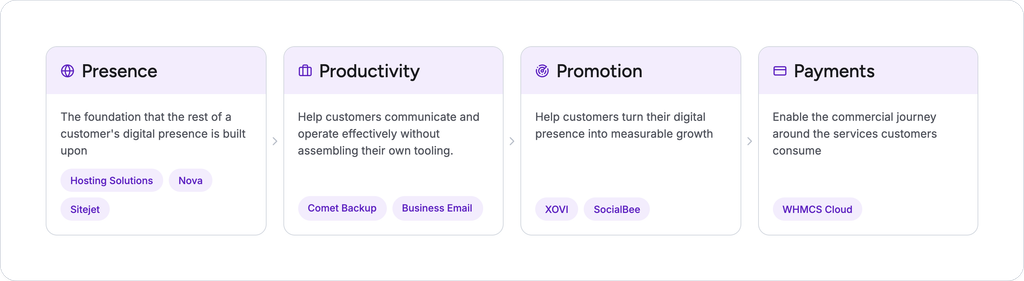
For partners, it is not simply adding nine products to sell, but four recognizable customer needs that can now be met within an existing customer base.
WebPros Cloud offers a route into those opportunities across five complementary categories, without requiring partners to build or manage the infrastructure behind any of them. The strongest customer relationships are rarely built around a single product. They are built by becoming valuable across more of the customer’s digital journey.
Become a WebPros Cloud partner and start expanding what you can offer. Sign up today.