

In today’s hosting market, providers often compete on the cheapest server plans and domain discounts, squeezing margins to nearly nothing. In such a cutthroat, commodity-driven landscape, one of the oldest internet services stands out for its stability: email. By attaching business email to domain and hosting sales, providers turn one-off transactions into ongoing relationships. While others race to the bottom on infrastructure, email delivers predictable, high-margin recurring revenue that few providers take full advantage of.
Why Business Email Still Matters in 2026
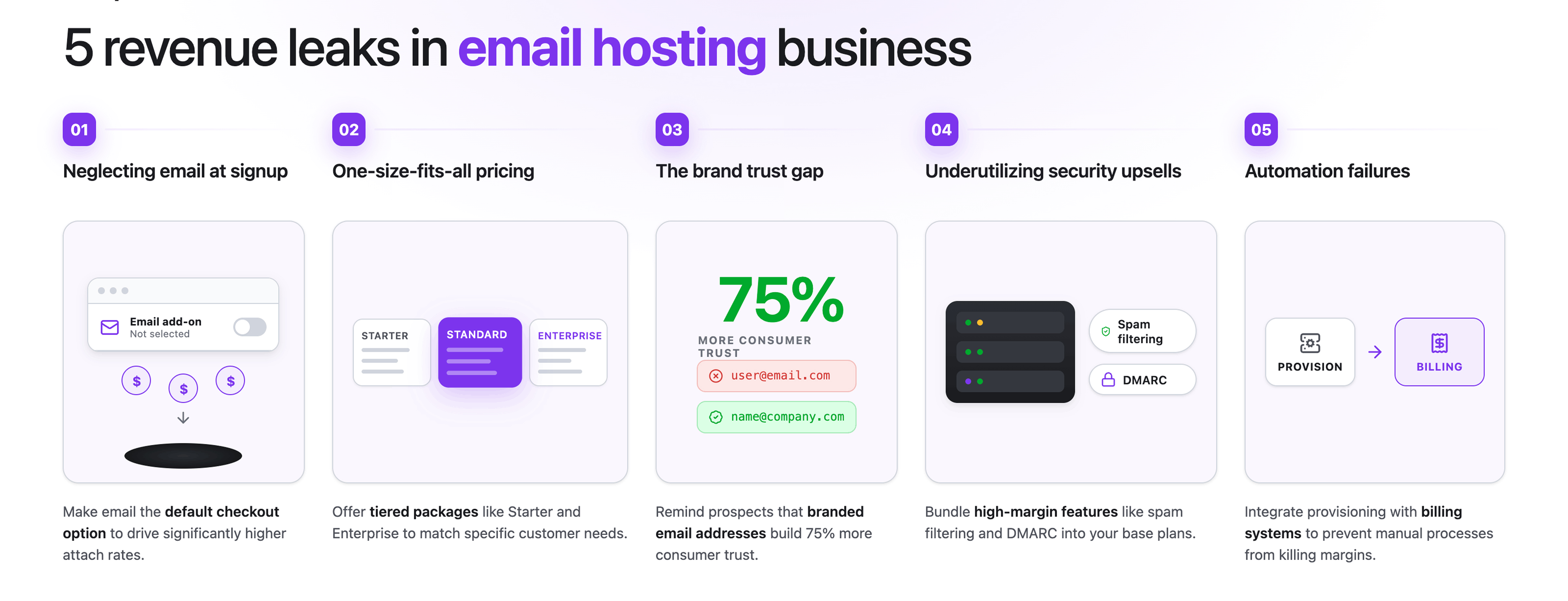
Email remains mission-critical for businesses of all sizes. Globally, over 4.4 billion people use email which is more than half the world’s population, with 376 billion messages sent each day. This enduring ubiquity makes email the de facto identity and communications hub for organisations. Studies show that 75% of consumers trust a small business more when it uses a professional, domain-based email address. In other words, an address like “[email protected]” instantly conveys legitimacy and stability. Free or generic emails (e.g. @gmail.com) are often viewed as unprofessional or even suspected by wary customers.
For hosts and registrars, this means offering branded business email is more than a box of storage. It’s about enhancing customer credibility. And once a company’s communications rely on a given mail system, switching becomes a major hassle. Migrating entire inbox archives, aliases, calendars and policies is technically difficult and risky. In practice, most businesses are willing to pay more for email reliability, security, and familiarity than for the cheapest possible provider. The result is that business email accounts tend to have very high retention: customers stick with their email host far longer than they do with their web hosting when a switching opportunity arises.
The Hidden Economics of Business Email
Providers who add business email hosting, tap into unusually strong unit economics. Key advantages include:
Recurring Monthly Revenue
Each mailbox is a subscription. This turns what might have been a one-time domain sale into ongoing monthly MRR. In fact, email hosting provides “a steady stream of predictable monthly income” that scales with the client’s team size. Once a customer has a domain, attaching even one mailbox converts a sporadic sale into regular renewals.
Higher Margins
Email services typically require far less infrastructure and maintenance overhead than a full hosting stack. Since you can charge per mailbox rather than per gigabyte of disk or server unit, each new seat adds lucrative incremental profit. For example, adding five $3/month mailboxes to a $10 hosting plan can triple that client’s monthly spend with you.
Multi-Seat Expansion
Businesses often start with a single mailbox but eventually grow. Each new employee, department, or service typically needs an email account. Unlike domains, which are one-off, email seats multiply. Providers can upsell storage or premium collaboration tools as clients expand. In practice, many hosts see email users upgrade to higher tier plans or add extra mailboxes over time.
Long-Term Retention
Because email is so sticky, customers with hosted mailboxes tend to stay longer. Once a business is committed to a branded email ecosystem complete with SPF/DKIM/DMARC setup and years of archived messages, they are far less likely to jump to a competitor’s cheap hosting offer.
Traditional Hosting Vs Modern Business Email
| Feature | Traditional Email Hosting | Modern Business Email |
| Primary Purpose | Basic mailbox functionality | Business communication and productivity suites |
| Collaboration Features | Limited or none | Shared calendars, contacts, collaboration tools |
| Security | Basic spam filtering | Advanced security, encryption, compliance |
| Scalability | Manual mailbox management | Easy user provisioning and multi seat growth |
| Revenue Potential for Providers | Limited or none | Recurring revenue with upsell opportunities |
Email Monetisation: More Than Just Mailboxes
Selling email isn’t limited to basic inboxes. Partners can drive additional revenue through value-added email services:
Premium Mailbox Plans
Offer tiered email plans. For example, a Starter plan might include a handful of free mailboxes with modest storage, while a Professional or Enterprise bundle adds unlimited aliases, larger attachment limits, or integrated calendars and office tools. By structuring “Starter, Business, Premium” tiers, you can upsell clients as their needs grow. Attaching extra storage or security features (encryption, archiving) to higher tiers gives clear upgrade paths.
Security and Compliance Add-Ons
Modern businesses care deeply about email security. You can charge extra for features like advanced spam filtering, virus scanning, email encryption, and automated backups. These services not only generate high margin revenue but also address clients’ real pain points.
Bundled Business Services
Create all-in-one packages. Many SMBs and agencies prefer a single provider for core IT. Combine domain registrations, hosting, and email into one bundle at a competitive price. You might offer a “Website + Email” bundle that includes a domain, hosting, and 5 mailboxes, positioning it as the default choice at checkout. You can even promote productivity suites (including webmail, calendars, and file storage) to further differentiate.
White-Label or Reseller Models
Many providers now offer fully branded email platforms for resellers and agencies. A white-label email solution lets you sell professional mailboxes under your own brand while the vendor handles the backend. If you already resell domains, adding a white-label email is the most natural way to strengthen your brand and grow recurring revenue. Resellers can then manage clients’ entire communications stack – domains, hosting, and email from one console, creating an integrated business ecosystem
What Hosts & Registrars Should Look for in an Email Platform
When choosing an email hosting solution to resell or bundle, focus on features that maximize reliability and ease-of-use:
Reliability & Uptime
Look for a provider with enterprise-grade infrastructure (global data centers, redundancy, and 99.9%+ SLA). Customers won’t tolerate frequent outages in their mail.
Security & Compliance
Ensure the platform has built-in spam/malware filtering and supports standard email authentication (SPF, DKIM, DMARC). Advanced features like email encryption, two-factor authentication for webmail, and archiving can be big selling points. The vendor should meet common compliance needs (e.g. GDPR, HIPAA)
Scalability
The system should handle growth effortlessly. Check if it can automatically provision new mailboxes via API or control panel, and whether storage quotas can expand as needed.
Easy Provisioning & Management
Your customers should be able to create, suspend, and upgrade mailboxes with minimal effort. A self-service reseller portal or control panel is essential for managing domains, DNS records, and mail accounts all in one place. Good platforms often include clear APIs and lifecycle hooks, so you can tie email provisioning directly into your signup and billing workflows.
Multi-Tenant/Reseller Support
If you sell to agencies or MSPs, ensure the platform supports white-label branding (custom logos, URLs, emails) and granular admin roles. It should let resellers issue invoices and manage invoices as if it were their own service. Ideally, you can fully rebrand the webmail interface and customer communications, so the end user never sees the underlying vendor.
Ecosystem Integration
Finally, the email service should play nicely with the rest of your stack. That means smooth domain validation, automated DNS (for MX, SPF/DKIM records), and compatibility with any site-builder or collaboration tools you offer. If you already provide SSL, DNSSEC, or backup services, the email platform should integrate with those to allow bundled offerings.
How Business Email Supports Revenue Growth
When positioned correctly, business email can be marketed as a scalable revenue layer on top of your existing services. It’s a natural upsell at domain checkout, simply suggest adding an email plan.
Email hosting also strengthens customer loyalty, which boosts revenue in the long run. Customers who buy email are more likely to renew multiple services together. Providers often promote email as a way to increase average account value and improve retention. The biggest benefits of selling email are “increased recurring revenue, unmatched customer ‘stickiness,’ and the ability to provide immediate, visible value to a client’s brand”.
By integrating email into your sales funnel, you essentially create a flywheel: higher ARPU from bundled services, which funds better support and marketing, which in turn attracts and retains more customers. Over time, this leads to more stable, long-term revenue. Providers that emphasize business email in their offerings often report uplift across their entire book of business. In short, email hosting is not just a bolt-on; it’s a profit amplifier – a simple way to grow each customer’s lifetime value, widen your margins, and deepen client relationships all at once.
For hosting providers, registrars, MSPs, and digital service providers, the challenge is not recognising the value of business email, it’s finding a solution that can be monetised efficiently at scale. The right email platform should help providers generate recurring revenue without introducing operational complexity.
WebPros Cloud Business Email is designed to help providers transform email from a basic hosting feature into a revenue-generating business service. With support for branded business email, multi-tenant management, reseller-friendly provisioning, and seamless integration into existing hosting ecosystems, providers can introduce professional email services as a natural extension of their current offerings.
This creates multiple opportunities to increase customer value. Providers can package email alongside domains and hosting, offer premium mailbox tiers, introduce security-focused add-ons, and expand revenue as customers add users and grow their businesses. Because email is deeply embedded in daily business operations, it also contributes to stronger customer retention and long-term account growth.
For providers looking to diversify beyond increasingly commoditised infrastructure services, WebPros Cloud Business Email offers a practical way to build predictable recurring revenue while strengthening customer relationships and expanding the overall value of their service portfolio.
Conclusion: The Most Mature Internet Service Is Still One of the Most Profitable
In an era when hosting and domains are increasingly commoditized; the true differentiator is what you do with them. Business email remains essential, trusted, and remarkably sticky, and yet many providers treat it as an afterthought.
Ultimately, the smart hosts and registrars will recognize that the future of growth may not lie in selling more servers or cheaper domains, but in owning the business communication layer. By integrating branded email into your ecosystem today, you not only deepen every customer relationship; you also secure a steady stream of revenue that will power your business into tomorrow.