

It’s easy to think of domains, hosting, and SSL as the core of a customer relationship, but those are also the easiest things for a customer to leave behind. Business email works differently. It’s the service people rely on every day, tied closely to how they present their business, and genuinely disruptive to switch away from once it’s set up. This article looks at why business email deserves a bigger role in how providers think about retention, what makes an email offering worth staying for, and how to package it so it feels like part of the business, not an afterthought at checkout.
Introduction
Business email can easily be treated as an accessory rather than a core part of the offering. A customer buys a domain, adds hosting, and email often gets folded in near checkout almost as an afterthought. It shows up in the upsell flow and earns a line item on the invoice but doesn’t always get the attention it deserves after that.
That’s a mistake, and not a small one.
Business email isn’t just another product sitting next to hosting and domains. It’s the service your customer opens first thing in the morning and last thing before they log off. It becomes woven into how they run their business, communicate with their clients, and present themselves to the world. That kind of daily dependence doesn’t just generate revenue. It builds the kind of relationship that keeps a customer from ever thinking about leaving.
The value of business email isn’t communication. It’s retention. And in a market where switching providers has never been easier, retention is the thing worth building around.
One Connected Setup, not a shelf of products:
Customer Retention Is the New Competitive Advantage
Acquiring a new customer in the hosting and registrar space costs more every year. Paid channels are more expensive, competition for the same keywords is fiercer, and customers have more options than ever to compare providers on price alone.
Growth that depends entirely on new acquisition is growth on a treadmill. You’re spending more to stand still. The more sustainable path is retention: keeping the customers you already have, extending how long they stay, and increasing what each one is worth over time.
This changes how you should evaluate every service in your portfolio. The question isn’t just “how much revenue does this generate on day one.” It’s “does this service make the customer more likely to still be with us in three years.” Some services answer that question well. Others don’t, no matter how much revenue they bring in upfront.
The math backs this up. A customer who churns after one year might be profitable on paper the day they signed up, but they cost far more to replace than they ever generated. A customer who stays five years, even at the same monthly spend, generates several times the lifetime value with none of the repeat acquisition cost. Retention doesn’t just protect revenue, it multiplies it, quietly, in the background, without needing a single new marketing dollar.
That’s why the smartest providers are shifting how they measure success internally. Instead of asking which product sold the most units this quarter, they’re asking which combination of services kept customers around the longest. Those two questions can have very different answers, and the second one is the one that actually predicts where the business will be in three years.
Why Some Hosting Services Are Easier to Replace Than Others
Here’s the uncomfortable truth about most of the products that providers sell: it’s replaceable.
A domain can be transferred to another registrar in a few clicks. Hosting can be migrated to a competitor, often with the customer barely noticing the difference. SSL certificates can be reissued anywhere. Infrastructure, as a category, is becoming more commoditized every year. Speed, uptime, and price are converging across providers, which means the things that used to differentiate a hosting business are turning into table stakes.
If the entire relationship with a customer is built on infrastructure, that relationship is only as strong as your next price comparison. A competitor undercuts you by a few dollars a month, or a customer reads one blog post about “how to switch hosts in 10 minutes,” and the relationship is gone. Nothing about infrastructure alone gives a customer a reason to stay when a cheaper or shinier option shows up.
That’s not a hosting problem specifically. It’s a stickiness problem. And it points to a bigger question: which solutions create the kind of dependence that keeps customers from leaving?
Business Email Becomes Part of Everyday Business Operations
Email is different, and the difference comes down to frequency and depth of use.
A customer doesn’t think about their hosting plan on a Tuesday afternoon. They don’t log into their domain dashboard between meetings. But they open their email dozens of times a day. It’s where they talk to customers, negotiate with suppliers, coordinate with employees, and send the invoice that gets them paid. Their calendars live there. Their contacts live there. Years of business correspondence live there.
Business email also carries something infrastructure never will: identity. A professional address tied to a company’s own domain is part of how that business presents itself to the world. It shows up on every email signature, every quote, every follow-up. It’s not a background utility. It’s front and center in how the business operates and how it’s perceived.
The pattern here is simple and worth remembering: the more often a customer touches a service, the more that service becomes part of how they work, and the harder it becomes to imagine replacing it.
Frequency builds dependence. Dependence builds retention.
Building an Ecosystem Customers Want to Stay In
Business email gets even stronger when it’s not standing alone. Paired with domain registration, hosting, security, and productivity tools, it becomes one piece of a connected setup that the customer relies on as a whole rather than as separate purchases.
When those pieces work together, something shifts in how the customer sees the provider. A vendor sells you a product. A technology partner runs the operational core of your business. Providers who deliver an integrated set of services, rather than a shelf of disconnected products, earn that second position. And partners in that position don’t get shopped on price the way commodity vendors do, because the cost of leaving isn’t just financial. It’s operational.
This is the real opportunity for providers: not selling more products, but building a setup sticky enough that customers stop actively considering alternatives.
Position Business Email as a Core Part of Every Business Package
If business email drives this much retention value, it shouldn’t be buried in an upsell flow. It should be positioned as a core part of every business package from day one.
That starts with packaging. Bundling professional email alongside domain and hosting purchases, rather than presenting it as a checkbox at checkout, signals that it’s essential rather than optional. It also means educating customers on what they’re actually giving up by skipping it: most small businesses don’t realize that a free, generic email address undercuts the professional credibility they’re otherwise trying to build. And it means shifting the framing entirely, from “would you like to add email” to “here’s your complete business setup, and email is part of it.”
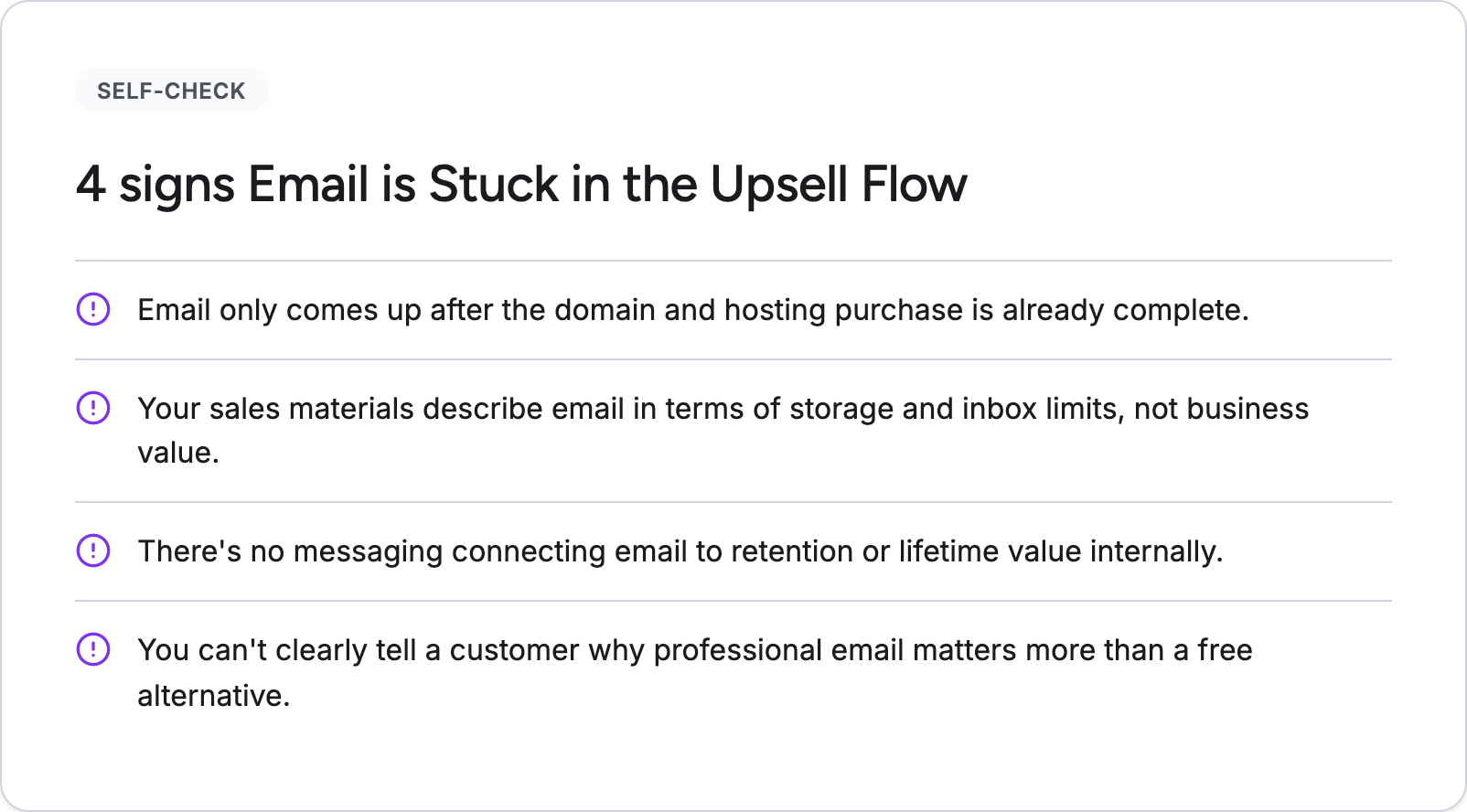
If more than one of these sounds familiar, email is underperforming as a retention lever in your business, not because the product is weak, but because the positioning is.
What Makes a Business Email Solution Retention-Ready?
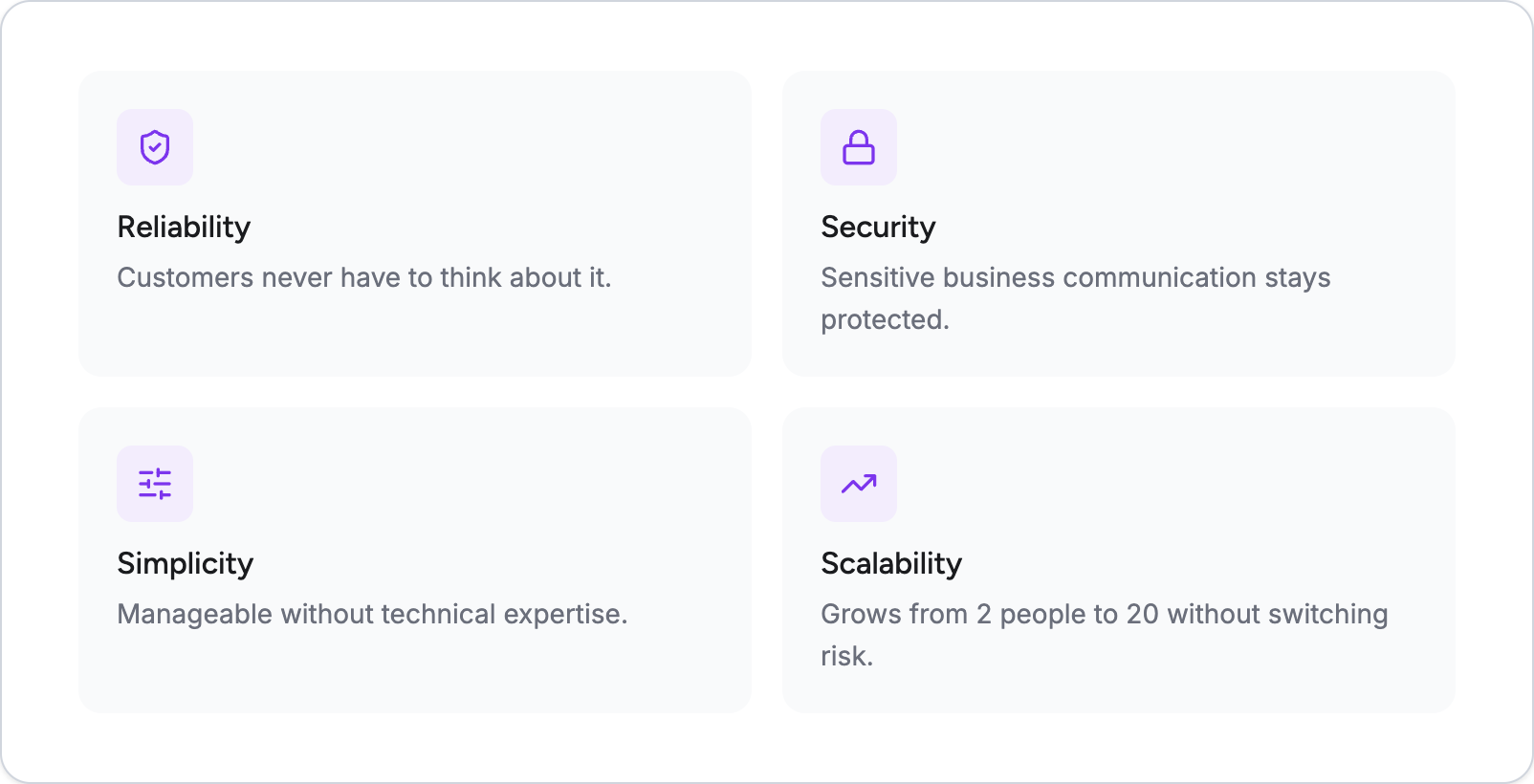
Not every email product earns its place as a retention driver. Retention-ready email has to hold up around a few specific things: reliability that customers never have to think about, security and data protection that keeps sensitive business communication safe, and a management experience simple enough that non-technical business owners aren’t left guessing.
Three Moves that make Email Stick:
It also has to scale with the customer. A two-person business and a twenty-person business have different needs, and an email solution that can’t grow with them creates its own switching risk down the line. Integration matters just as much. Email that works cleanly alongside existing domain and hosting services feels like part of one setup. Email that feels bolted on undoes a lot of the stickiness this whole strategy depends on.
Get these right, and email stops being a line item. It becomes infrastructure the customer builds their business around, which is exactly the position you want to hold.
There’s a packaging dimension worth calling out separately, because it’s where a lot of providers leave value on the table. Bundling email into a starter package at signup, rather than surfacing it as an upgrade later, removes the moment where a customer has to actively decide email is worth paying for. Tiering email by mailbox count or storage as a business grows gives providers a natural upsell path that doesn’t feel like a hard sell, because it’s tied to something the customer already understands: their team is bigger, so they need more seats. And pairing email with onboarding support, rather than leaving customers to configure DNS records on their own, removes the single biggest reason customers delay setting it up in the first place. None of this requires new technology. It requires treating email as a packaging decision instead of an afterthought.
Business Email as a Foundation for Long-Term Customer Relationships
Put the pieces together and the pattern is clear. Daily engagement builds habit. Operational dependence builds switching cost. Integration across services builds trust. And all three together build the kind of loyalty that survives a competitor’s better price.
Retention built this way compounds. A customer who stays three extra years because their email, hosting, and domain are woven together is worth far more than the incremental revenue from one more upsell. Providers chasing growth purely through new acquisition are working harder for less durable results than providers who build offerings customers don’t want to leave.
Conclusion
Business email is not an ancillary service, and it never really was. It’s one of the few things in a typical hosting and registrar stack that customers touch every single day, tie directly to their business identity, and would genuinely struggle to replace without disruption.
Providers who keep treating it as a checkout afterthought are leaving one of their strongest retention tools on the table. Providers who position it as a core part of every business package and build it to the standard that daily dependence demands, put themselves in a fundamentally stronger position with every customer they sign.
In a market where infrastructure is increasingly interchangeable, the services customers rely on every day become the strongest reason to stay. Business email isn’t just another product. It’s the foundation of a longer-lasting customer relationship.
See how a retention-ready business email solution fits into your offering: Explore Business Email